Friday, April 5, 2013

Kaarli Lutheran Church in Tallinn

Visited March 30, 2013


Charles XI Lutheran Church, or Kaarli Kirik, is Tallinn's grandest 19th-century church, and the only one in Tallinn with twin steeples.

It is a neo-Roman style church built over twenty years from 1862 to 1882 as a long overdue replacement for the original Kaarli Church. That church was founded in 1670 on the order of Sweden's King Charles XI, but like many wooden structures outside the city wall, the first Kaarli Church burned down during the Great Northern War in the early 1700s.

The present limestone church was built by architect Otto Pius Hippius from St. Petersburg using a special arch technique that gives it have a vast, open interior. It can seat 1,500, and I can attest to its wonderful acoustics...I once sat (hid) in the back and could hear perfectly.

According to Tallinn's tourism website, Kaarli Church is home to the first Estonian fresco, “Come to Me,” painted in 1879 by famed Tallinn artist Johann Köler. The church also boasts the country's largest church organ, installed in 1924. Services are still held at Kaarli Church on Sundays at 10am, and in fact, this is actually the only church I have attended services in since coming to Estonia. Well, that is sort of true. I did attend a concert in Niguliste Kirik, but it wasn't a church service and the church is actually a museum now.

But I have been to a Thanksgiving service at Kaarli. All in Estonian. It was beautiful, but challenging.

Sadly, I couldn't get inside Saturday. So I was only able to get exterior pictures.


Thursday, April 4, 2013

Orthodox Cathedral of St Simeon and the Prophetess Hanna in Tallinn

Visited March 30, 2013


This is a church I have never noticed. It is on a street I have been down, but if I ever saw it, it just didn't jump out.

The Orthodox Cathedral of St Simeon and the Prophetess Hanna was begun in 1752 and completed in 1755.

It is located down near the harbor on the route I usually take to catch the ferry to Helsinki. It is a pretty little wooden church that looks like it came out of a fairy tale. It was build on the initiative of Russian sailors, and it the second Orthodox church to have sprung up as part of the suburban building boom that followed the Great Northern War. The first, as you know, was the Orthodox Church of the Nativity of the Mother of God (Kazan Icon) that I wrote about yesterday.

The coastline in this area was considerably closer to the city then than it is now, owing to the land being filled it, so this church was practically on the edge of the water, and legend has it that rubble from shipwrecks was used for landfill for the church.

Like most churches in Estonia, the building was seriously damaged during Soviet times, when it was turned into a sports hall. During that time, it lost its bell tower and onion dome, but the church was fortunatley restored after Estonia re-independence. Since 2001, an Estonian Orthodox congregation has been active there, and they have services on Sundays at 10am.

Luckily for me, this church was open, so I was able to get some shots of the beautiful interior as well.


Wednesday, April 3, 2013

Orthodox Church of the Nativity of the Mother of God (Kazan Icon)

Visited March 30, 2013


I see this church nearly every day, but I had never taken a picture of it. I had been told, incorrectly as it turns out, that it was built in 1901. So it was just outside of my date range. Still, it was one I planned to do a post on anyway, just because it was cool looking. It was just filed under "when I get around to it."

With a little spare time on Easter weekend, I decided to look it up on the internet and wander over to take some pictures. It is only a few blocks from my apartment.

Turns out, the Orthodox Church of the Nativity of the Mother of God (Kazan Icon), was not built in 1901.

It was built in 1721, and is the oldest specifically orthodox church in Estonia.

The church was the first church to be completed after the Great Northern War in the early 18th century, a conflict that ended with Estonia under tsarist Russian rule. After the war, Tallinn's suburbs were growing quickly as the town was absorbing more and more Russian immigrants. And so churches like Our Lady of Kazan were built.

Even the repairs are older than 1901...the church was repaired extensively in the 19th century, giving it a neo-classical façade and interior. And sevices are still held there, on Saturdays at 5pm and Sundays at 8am. I even saw a priest in the churchyard (you can see him in the bottom picture).


Tuesday, April 2, 2013

St Lawrence´s Lutheran Church in Pühalepa

Visited March 27, 2013


The last church I visited while out on Hiiumaa was St Lawrence´s Lutheran Church in Pühalepa.

Built in the 1200s, it is apparently the oldest building on the island. The church was turned into a grain store in 1951 but was restored to the congregation and re-consecrated in 1993. Choir vaults and painted crosses on the Western wall, none of which I got to see (darned locks!) are from the Middle Ages and the 19th century. There is a baroque funeral chapel in the churchyard that belonged to the Unger-Stenbock family.


EDIT:
I revisited the church on June 14, 2014, and was able to take a few more pictures. I thought I would share them with you. The inner door was still locked, but the outer wasn't, so I got a shot of the interior this time.


Monday, April 1, 2013

St John the Baptist Lutheran Church in Kärdla

Visited March 27, 2013


On my second day out on Hiiumaa, I got a chance to visit St John the Baptist Lutheran Church in Kärdla.

Built in 1863, this is a simple stone church built on the site of a previous wooden chapel for the people who worked in the nearby textile mill (run by the Unger-Stenberg family, whose relatives I might be descended from) with money raised by the workers themselves. The wooden tower was added in 1929. I couldn't get inside, but apparently the altar painting ”Christ on the Cross” dates from 1889.


Outside, there is a new monument to those deported during Soviet times. Monday was the 64th anniversary of the deportations, where as many as 20,000 Estonians were deported over the course of four days, and candle-lighting services were held throughout the country, including here on the island at this new memorial.

Sunday, March 31, 2013

St Nicholas Lutheran Church in Haapsalu

Visited March 26, 2013


Happy Easter!

In celebration of the holiest day in the Christian calendar, I bring you St Nicholas Lutheran Church in Haapsalu, part of the Haapsalu Episcopal Castle.

I visited this church as I headed out to Hiiumaa for our America Days events there. I will be coming back to the castle this summer for some events we have scheduled (stay tuned, Public Diplomacy fans!), and I promise some additional (hopefully interior) pictures then.

This cathedral was constructed around 1265, and famous for the White Lady who believed to appear at the window of its baptismal chapel on full moon August nights (note to self...visit in August!).

Apparenlty during the reign of Ösel-Wiek Bishop, according to the monastary's rules, every canon was supposed to lead a chaste and virtuous life, and access of women to the Episcopal Castle was forbidden by threat of death. Legend has it that a canon fell in love with an Estonian girl and secretly brought her into the castle. She hid by dressing as a choirboy and remained a secret for a long time, but when the bishop visited Haapsalu again, the young singer caught his attention and he ordered an investigation of the singer's gender.[

When he discovered the singer was a girl, the bishop and his his council decided to entomb the girl in the wall of the chapel, and to imprison the canon, where he was starved to death. The girl was walled into a cavity in the wall, left with only a piece of bread and a mug of water. Her cries could be heard for some time, a warning to anyone else who might try such a trick. The legend says her soul could not find the peace and this is why she appears on the Baptistery’s window (pictured below) to grieve for her beloved and to prove the immortality of love. I think she appears because of the horrific way she died. Let's just say I'd be inclined to haunt a place where something like that happened to me!

The place still functions as a church (despite the ghost!). The congregation was dispossessed during the Soviet times, but the church was reconsecrated and restored in 1990.


Visited again May 8, 2013

I took a few other pictured while visiting today, including the one above of the window the White Lady appears in.


Saturday, March 30, 2013

St Lawrence Lutheran Church in Kuressaare, Saaremaa

Visited February 27, 2013


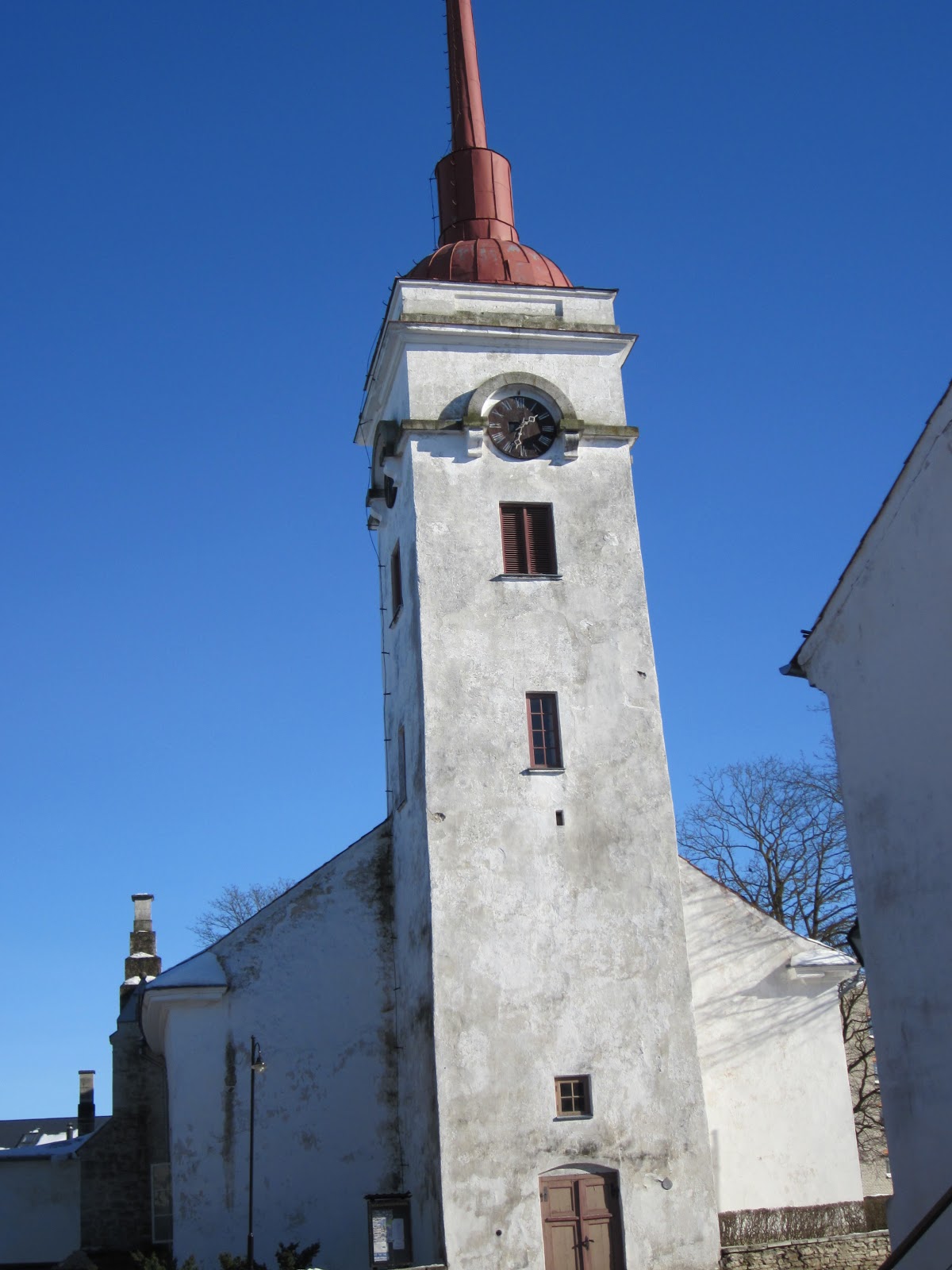
St Lawrence Lutheran Church in Kuressaare is located in downtown Kuressaare on the island of Saaremaa. I have seen it several times, but never had a chance to take a picture until this regional outreach trip.

The church was built in 1733 and rebuilt in 1836. The interior is apparently original, though I couldn't get inside because they were actually doing some restoration work while I was there. Apparently it houses the medieval baptismal font from Anseküla church.